Badminton Techniques

Badminton Footwork Split Step Technique: Base Recovery and Directional Flows

The most common split-step mistake is mistiming the landing, which leaves the athlete flat-footed when the opponent’s next shot is already underway. That usually happens because the player watches the shuttle too long, moves the feet before the opponent commits, or lands with no active base to push from.

This article fixes the split step as a timing system: pre-activation, base recovery, directional exit, and the shoe setup that keeps the platform reliable.

Badminton Footwork Split Step Technique: Base Recovery and Directional Flows

Mechanics of the Pre-Activation Split Jump

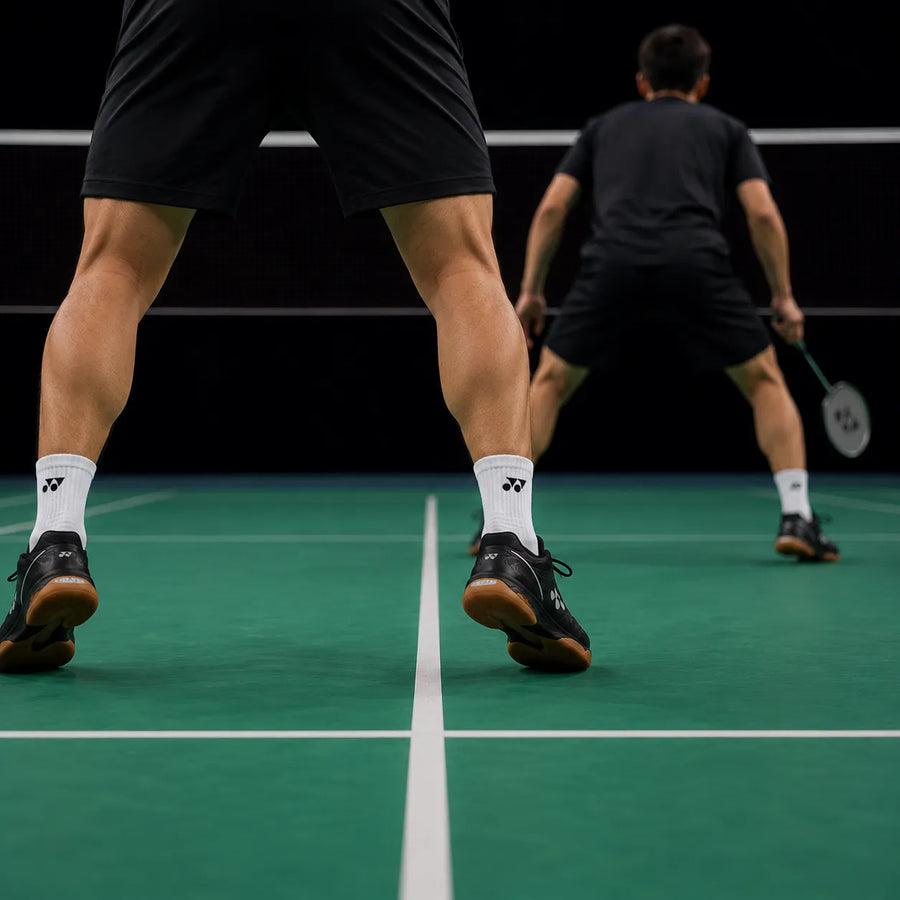
The split step is not a jump for height. It is a pre-loaded micro-hop that places the athlete in a brief aerial phase so both feet can reload into a responsive base the instant the opponent’s contact cue appears. The landing position should be slightly wider than shoulder width, knees flexed, hips ready to hinge, and trunk stacked so the center of mass can move without delay.

If the landing is too narrow, the athlete cannot redirect cleanly; if it is too wide, the legs lose spring and the first push becomes slow. The useful mechanism is elastic pre-tension. As the athlete lands, ankle dorsiflexion, knee flexion, and hip flexion absorb force and store it for the next direction change, while the feet remain light enough to avoid sticking to the floor.

The split step should finish just before the opponent strikes, not after the shuttle has already been released, because the landing itself is the moment that turns visual information into movement readiness. The point is to reduce reaction lag by arriving in a state of organized tension rather than static standing. A technically clean split step also depends on upper-body restraint. If the shoulders lean backward or the torso twists excessively during the hop, the athlete spends the next step correcting balance instead of attacking space.

The best movement looks compact because the legs are doing the work of preparation while the trunk stays neutral enough to let the base recover instantly. This is the logic behind the baseline principles: the split step is a timing gate, not a fitness test. For a broader structural reference on establishing your primary stance variations, master your baseline setup configurations using our comprehensive badminton guide.

Core Recovery Back to the Central Base

Recovery is the real value of the split step. The athlete is not simply landing and moving; the body is resetting to a central base that can feed either side with equal speed. That means the feet must land in a position that allows the hips to load laterally, the pelvis to stay level, and the first push to be generated from the leg nearest the direction of travel. If the base is too far behind the shuttle line, every recovery step becomes a chase instead of a controlled exit.

The physics are straightforward. Once the split-step landing absorbs force, the athlete uses the stored elastic energy plus a rapid push from the stance leg to move the center of mass toward the shuttle. The best recoveries minimize wasted vertical motion and maximize horizontal transfer, because the opponent’s shot is usually decided by first-step quality, not by how hard the athlete tries after the fact. A clean base gives the player a shorter path to the next shot and reduces the time spent re-centering after contact.

The trunk should re-stack over the hips during recovery, not drift outside the support line. If the athlete leans too far forward during movement, the feet must compensate with extra braking; if the chest remains too upright, the first step lacks aggression. Recovery becomes efficient when the body stays quiet above the pelvis and the legs handle the directional change. This is why the split step belongs to movement economy, not just anticipation.

Lunging and Directional Change Execution

Directional flow begins with the first push after landing. For a forecourt lunge, the lead foot reaches only as far as the body can support without the rear leg collapsing, because overreaching kills the return path and turns the next recovery into a drag. For a rear-court change, the athlete must drive from the loaded leg and use the opposite arm to stabilize trunk rotation while the hips open just enough to move efficiently. The split step is successful only if the body exits cleanly into the next action.

The biggest technical loss happens when athletes step before they have committed the direction of force. A hesitant first step creates extra foot contacts and slows the center of mass. Instead, the athlete should read the opponent, land into the split, and immediately choose the shortest path to the shuttle with minimal corrective steps. The feet need to cover ground, but the hips and shoulders must stay organized so the directional change does not collapse the kinetic line.

The movement becomes sharper when the athlete understands that braking and propulsion are paired actions. The landing leg absorbs vertical ground reaction force, and the next push reuses that stored energy to accelerate laterally or forward. If the knees cave inward or the ankle stiffens, the transfer becomes noisy and slow.

A practical correction drill is to perform split-step landings on a marked court line, then explode to alternating forehand and backhand corners while keeping the first push low and the recovery path direct; stop each rep if the landing drifts or the second step appears before the body is balanced. To reinforce these precise contact boundaries across an advanced multi-shot layout, cross-reference this pathway with our comprehensive badminton techniques directory.

Keeping Your Movement Shoes Friction-Ready

Footwork quality depends on the shoe as much as the movement pattern. A sole that has lost grip delays the first push, while a shoe with too much sticky resistance can trap the foot during directional changes and stress the knee and ankle. The athlete needs a friction level that allows quick braking on landing and clean release on push-off, especially on dusty or humid courts where traction changes from session to session.

Maintenance is part of performance. Worn tread, packed dust, and compressed midsoles all reduce the clarity of the split-step landing and make base recovery less predictable. Shoes should be cleaned often enough that the outsole can still read the floor, and they should be rotated when the cushioning no longer returns energy cleanly. Fatigue matters too, because tired calves and foot intrinsics reduce the precision of ankle dorsiflexion and make the split step heavier than it should be.

The split step is only as fast as the athlete’s contact with the ground. When the shoe is responsive, the body can trust the landing and move immediately; when the shoe is dead, the player hesitates and the rally advantage disappears. Movement quality is never just technique, because friction, cushioning, and court feel shape the execution.

Summary

A strong split step gives the athlete a timed landing, a usable base, and a direct path into the next movement. When the feet, hips, and shoes all support the same directional flow, recovery becomes faster without wasting steps. For players building their foundational front-court patterns, a comprehensive beginner's guide is available to scale your baseline skills, while structural equipment integration updates can be systematically tracked inside our technical badminton gear guide.