Badminton Techniques

Badminton Overhead Smash Technique | Kinetic Chain and Contact Points

The most common smash error is not a lack of strength; it is a broken kinetic sequence that leaks force before the shuttle is contacted. That happens when athletes jump or swing with the arm first, then try to add trunk rotation and wrist action too late.

This article fixes the smash from the ground up: body position, force transfer, contact timing, and the small corrections that keep power from collapsing into strain.

Badminton Overhead Smash Technique | Kinetic Chain and Contact Points

Body Positioning and the Interception Window

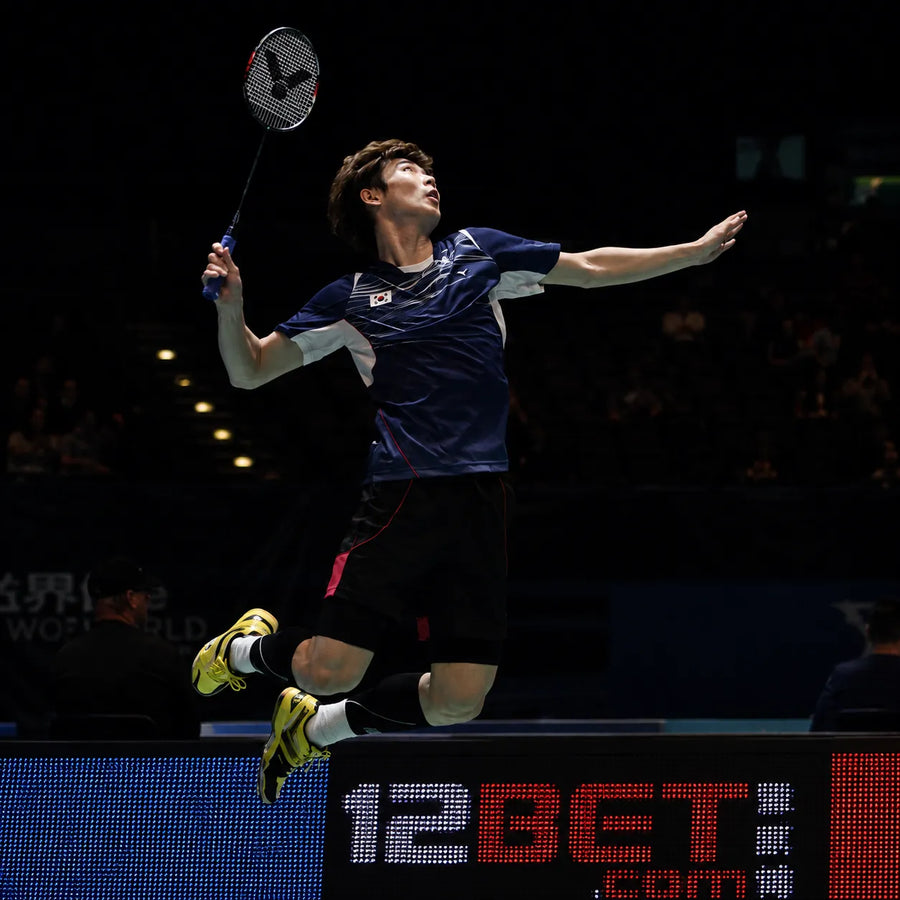
A good smash begins before the racquet moves, requiring rapid retro-stepping to establish a tracking posture completely posterior to the falling apex of the shuttlecock. The athlete must arrive with the chest side-on, the hitting shoulder stacked behind the non-hitting shoulder, and the pelvis prepared to rotate without drifting off balance.

The goal is to create a stable interception window above and slightly in front of the head, where the shuttle can be struck at full reach without forcing the shoulder into compensation. To ensure absolute control during this setup phase, the hand grips the handle in a flexible forehand V-grip profile, where the thumb and index finger form a clear V-shape along the top ridges while the lower three digits maintain minimal mechanical pressure under 10% contraction during the preparation phase to maximize terminal velocity.

The body is organized so each anatomical segment can contribute in sequence; hip loading, thoracic rotation, scapular upward rotation, and shoulder external rotation create the storage phase, while the front side remains quiet to prevent energy loss through premature opening. The rear leg provides base stability, but the real value is in positioning the center of mass so the athlete can rise, rotate, and land without collapsing the trunk. This is where the baseline principles matter: the smash is built on position first, then speed. For a broader structural reference on establishing your primary stance variations, master your baseline setup configurations using our comprehensive badminton guide.

Contact height matters because it changes the margin for error. A contact point that is too low forces the elbow to extend under pressure and reduces the available downward angle, while a contact point that is too far behind the head shortens the stroke and blunts power. Elite smashers protect the interception window by arriving early, holding the non-hitting arm up long enough to stabilize trunk rotation, and keeping the hitting elbow high before the final extension.

Kinetic Chain Power and Forearm Rotation

Smash power is a proximal-to-distal transfer problem where the legs create the ground reaction force, the hips and trunk convert that force into rotation, the shoulder accelerates the upper arm, and the forearm and hand finish the chain. If any link fires too early, the later links lose load and the final racquet-head speed drops. The useful idea is not to hit harder, but to delay the fast segment until the larger segments have already accelerated. Compressing this firing order allows kinetic energy to multiply through each anatomical link, ensuring that ground reaction forces pass efficiently through the core musculature and torso directly into the racquet shaft.

The lower body contributes through plant-and-drive mechanics, not through a blind jump; a well-timed push from the legs creates upward and forward impulse, while trunk rotation adds angular momentum that is passed into shoulder internal rotation and elbow extension. Rapid radioulnar forearm pronation then sharpens the racquet path, driving the racquet face from a side-facing profile to full square exposure within milliseconds of hitting the target zone for a steep, penetrating finish. The result is not just speed, but a trajectory that forces the shuttle downward before the defender can reorganize.

Timing is the entire shot. If the trunk opens too early, the arm has nothing to accelerate against, and if the elbow extends too soon, the wrist and forearm cannot add their late-stage contribution. The best smashers keep the hitting side loaded while the body is still rotating, so the racquet whips through with a clear sequence rather than a single muscular shove. To reinforce these precise contact boundaries across an advanced multi-shot layout, cross-reference this pathway with our comprehensive badminton techniques directory.

Optimizing the Wrist Snap at Peak Extension

The wrist snap is often misunderstood because the visible motion is small, but its effect is large. The real action is a combination of rapid forearm pronation, controlled wrist flexion or ulnar deviation, and dynamic finger tightening at the exact moment the arm reaches near-full extension.

The wrist does not create the entire smash; it refines the final racquet angle and adds terminal velocity when the racquet is already moving fast. Structural impact occurs at the absolute peak of the player's reach, approximately 15 to 20 degrees forward of the vertical shoulder axis to catch the shuttle within its optimal downward projection window.

Peak extension should happen just before contact, not after it; if the wrist action arrives early, the racquet decelerates before the shuttle is struck cleanly, and if it arrives late, the shuttle is contacted with an open face and the shot floats. The correct pattern is a late, compact release that preserves racquet-head speed through the interception window and closes the face through contact without excessive looping. Torso rotation forces the hitting shoulder forward during contact, allowing the racquet face to maintain absolute line stability long enough to compress the cork without slicing the feathers.

Self-diagnosis is straightforward. A smash that flies long usually reflects a contact point that is too late, a racquet face that opened early, or a trunk that rotated before the arm was set. A smash that lacks depth or pace often comes from poor leg drive, a collapsed elbow, or a wrist that was squeezed before the final segment accelerated. A useful correction drill is to shadow three sets of five smashes with a pause at the loaded position, then add shuttle feeding and strike only when the elbow stays high and the contact point is clearly in front of the head, which keeps the athlete from chasing power with the arm alone.

Preventing Post-Smash Fatigue with Proper Recovery Flow

Repeated smash volume taxes the shoulder complex, forearm flexors, and the posterior chain more than athletes often realize. The deceleration phase is especially costly because the rotator cuff, scapular stabilizers, and trunk must absorb the intense forces created during the strike.

The landing leg absorbs the forward momentum through an immediate split-step recoil stance, lowering the center of gravity to reset baseline court coverage without allowing muscular stiffness to freeze the next recovery movement. When that braking system gets tired, smash mechanics degrade fast: the elbow drops, the torso opens early, and the wrist starts compensating for lost speed.

Recovery begins with managing load, not just soreness; high-volume smashing sessions need spacing so the shoulder and thoracic spine can restore rotational quality before the next intensity block. After training, the athlete should restore scapular position, unload the forearm, and reduce stiffness in the chest and lat chain so the next session does not start from a shortened, guarded posture. Grip pressure also matters because a clenched hand after repeated smashing keeps the forearm on alert and slows recovery, making hand opening work and brief grip resets essential.

Equipment contributes to fatigue in a subtle way. A stiff racquet frame that is too head-heavy for the athlete’s current strength profile can exaggerate shoulder load, while loose strings create an unpredictable trampoline effect that forces the player to swing harder for the same shuttle speed. The best setup features high string tensions ranging from 26 to 30 lbs to translate maximum impact force directly to the shuttle, but it demands rigorous physical conditioning routines to manage structural vibrations over long match sets. When load is controlled, the smash stays explosive longer and the technique remains usable deep into a match.

Summary

A powerful smash depends on position, sequencing, and a late contact point that preserves the kinetic chain until the last moment. For players building their foundational overhead patterns, a comprehensive beginner's guide is available to scale your baseline skills, while structural equipment integration updates can be systematically tracked inside our technical badminton gear guide.