Badminton Techniques

Badminton Short Serve Technique | Precision and Trajectory Control

Many intermediate badminton players struggle with the short serve because inconsistent thumb placement or excessive pushing force causes the shuttle to sail too high over the tape, leaving it vulnerable to an immediate net kill.

This article maps out the exact mechanical adjustments, backhand grip modifications, and trajectory constraints required to deliver a tight, low-margin short serve that forces a defensive lift.
Badminton Short Serve Technique | Precision and Trajectory Control

The Backhand Grip and Thumb Stabilization

The short serve starts with a backhand grip that is not truly “backhand” in the casual sense; it is a controlled neutral-to-backhand hold where the distal phalanx of the thumb rests flat on the wide, dominant bevel of the handle, choked significantly upward near the cone boundary to maximize short-range directional leverage and fine spatial control. The index, middle, ring, and pinky fingers loop loosely around the adjacent handle facets, maintaining a calculated spatial gap between the palm skin and the grip surface while the agonist forearm flexor muscles are strictly restricted to under 15% of maximum voluntary contraction to prevent premature joint stiffening or uncalibrated muscle spasms during the pre-contact phase. The racquet face is oriented with an intentional upward tilt of exactly 10 to 15 degrees relative to the vertical plane to dictate a tight, skimming baseline trajectory.

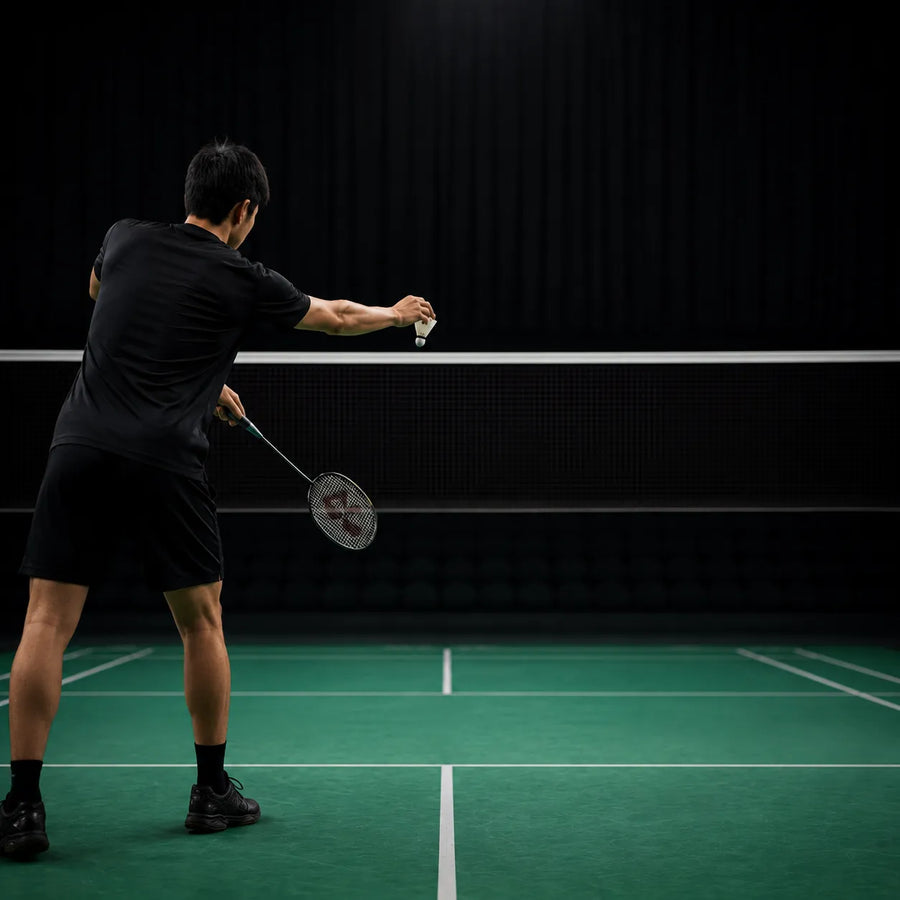
The player assumes a solid non-racquet foot forward stance with the center of mass shifted anteriorly over the lead knee, holding the shuttle feathers by their extreme tips between the thumb and index finger to suspend the cork base 2 to 5 cm directly in front of the central string bed. To satisfy legal readiness constraints defined by international standards, the entire shuttle must remain below a maximum height threshold of 1.15 meters at the exact instant of impact, meaning a dropped elbow configuration close to the ribs represents a critical spatial setup error that limits structural arm articulation and skews the swing plane. For a broader structural reference on establishing your primary stance variations, master your baseline setup configurations using our comprehensive badminton guide.

Executing the Low-Trajectory Pushing Motion

The forward hitting stroke initializes through a brief, controlled backward draw via subtle elbow flexion, transitioning immediately into a continuous, low-velocity forward translation powered by steady elbow extension and a restricted forearm pushing force. The joint rotation sequence relies completely on this elbow extension while the wrist joint remains strictly locked in a neutral, splinted position to suppress dynamic snapping, uncalibrated velocity spikes, or flicking motions that ruin depth consistency. Shuttle contact occurs at the absolute nadir of the forward pendulum arc, positioned slightly anterior to the forward knee boundary, resulting in a responsive string-bed dwell window lasting between 4 to 6 milliseconds.

Force transmission originates from the shoulder girdle complex stabilizing the upper arm, flows through progressive elbow extension, and transfers down the racquet shaft via late finger compression against the handle facets at the precise millisecond of impact. Positional metrics require a highly flat forward hitting path limited to an intentional 10 to 15 cm trajectory, completely eliminating any secondary follow-through or sweeping motions to ensure the shuttle does not accidentally sail deep past the short service line. To reinforce these precise contact boundaries across an advanced multi-shot layout, cross-reference this pathway with our comprehensive badminton techniques directory.

Managing Net Clearance and Intended Placement

Aerodynamic drag profiles dictate that the shuttlecock decelerates exponentially immediately post-impact, requiring a highly precise parabolic flight arc that peaks on the server's side of the court before executing a sharp downward plunge post-net clearance. The structural target window for optimal trajectory control demands a net clearance margin of only 20 to 50 mm above the tape, denying the receiver an early front-court interception or an aggressive downward return trajectory. High, loose clearance trajectories indicate a racquet face tilted too far upward or an un-isolated wrist snap, which require locking the wrist and dropping the racquet head angle closer to the vertical plane.

Striking the net or dropping short indicates an uncalibrated deceleration profile right before impact, which must be corrected by maintaining a uniform acceleration curve across the entire forward push phase. Advanced performance thresholds mandate an accuracy baseline where $\ge95\%$ of executed serves drop within a 10 cm target rectangle adjacent to the opponent's short service T-junction line. This strict parameter is achieved during court sessions by placing target markers and executing low-amplitude ghost serving repetitions over a narrow visual ceiling rather than blindly guessing the force required.

Organizing Your Kit to Protect Your Racquet Grips

High string tensions spanning 28 to 32 lbs shorten the dwell time of the shuttle on the string bed and demand precise tactile touch, providing direct velocity feedback compared to lower tensions that generate an unpredictable trampoline effect. Excessive hand perspiration reduces handle friction and causes micro-slippage that alters the racquet face angle by 1 degree to 2 degrees, necessitating the deployment of highly absorbent polyurethane overgrips to keep the hand-grip interface stable. A head-light or balanced racquet profile is optimal for short serve consistency, minimizing frame inertia to allow micrometric control over low-force push paths.

To protect these precision handles and strings from atmospheric moisture, dirt, and structural degradation between training sessions, utilizing a dedicated sports bag with insulated compartments is highly required. Keeping your primary equipment stored within a specialized thermal shell ensures your exact configurations remain clean, predictable, and fully uncompromised under match pressure.

Summary

A reliable short serve comes from a stable grip, a quiet body, and a racquet face that delivers the shuttle on a tight, repeatable line. For players building their foundational front-court patterns, a comprehensive beginner's guide is available to scale your baseline skills, while structural equipment integration updates can be systematically tracked inside our technical badminton gear guide