Volleyball Training Learn

How to Improve Your Jump for Volleyball

Whether you play as a hitter, blocker, or setter, your vertical jump directly affects how much you can contribute at the net and how much pressure you put on the opposition. A limited jump height costs you attacks, blocks, and the physical confidence to compete against taller, more explosive players.

This article breaks down the training methods, physical requirements, and technique adjustments that will help you jump higher on the volleyball court.
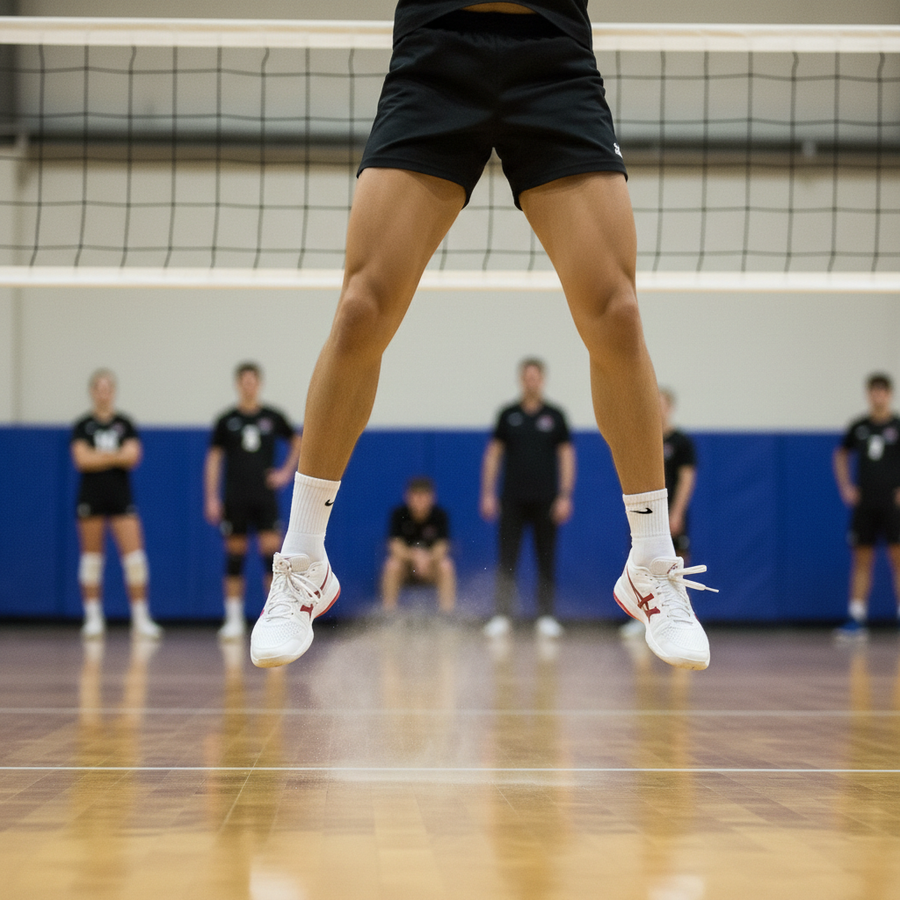
How to Improve Your Jump for Volleyball

Why Your Vertical Jump Matters More Than Height

Plenty of shorter volleyball players compete effectively at high levels because they have developed strong, well-trained jumps. Height gives you a starting advantage, but jump training is what closes the gap and, in many cases, reverses it entirely.

Your vertical jump is powered by the lower body, specifically the quadriceps, hamstrings, glutes, and calves working together through the takeoff phase. However, two elements that players routinely underestimate are core stability and arm swing. A well-timed arm drive at takeoff generates upward momentum through the entire body and can add several inches to your peak height when executed correctly.

Mobility is another overlooked factor. Tight hip flexors or restricted ankle range of motion limits how much force your muscles can produce during the push-off. Addressing these restrictions often unlocks jump improvement before any strength or power training even begins. Starting with a simple daily mobility routine for the hips and ankles takes ten minutes and produces results that compound over weeks of consistent practice.

Understanding which physical qualities drive jump height means you can train them directly, rather than simply jumping more and hoping the number goes up.

Strength Training That Builds a Foundation for Jumping

Raw jump height comes from force production, and force production is built in the weight room. Plyometric drills get a lot of attention in volleyball training circles, but they deliver far better results when they are built on a solid base of lower body strength. Skipping the strength work and going straight to jump training is like trying to accelerate an underpowered engine.

Squats are the most important exercise for volleyball players looking to jump higher. Both back squats and goblet squats train the full lower body chain through ranges of motion that closely mirror what happens during an attack approach. Romanian deadlifts develop the posterior chain, particularly the hamstrings and glutes, which power the hip extension during takeoff. Bulgarian split squats build single-leg strength and help correct the left-to-right imbalances that quietly limit jump height in players who have never trained unilaterally.

Calf raises deserve a place in the programme too. The calves contribute significantly to the final push-off phase, especially in the arm-assisted approach jump that volleyball attacks rely on.

For a broader look at how strength development fits alongside technique, tactics, and conditioning work, the volleyball guide brings all of that together in one place.

Train lower body strength two to three times per week, with at least one full recovery day between sessions. Progress gradually by increasing load rather than adding exercises or volume before the basics are well-established.

Plyometric Training and the Stretch-Shortening Cycle

Once a strength base is in place, plyometric training converts that strength into the explosive, rapid-fire power that volleyball demands. The reason plyometrics work is that they train the stretch-shortening cycle, the fast eccentric-to-concentric muscle contraction that produces athletic explosiveness. This is the same mechanism driving a volleyball approach jump.

Box jumps are a common starting point and teach the body to produce maximal effort in a single explosive movement. Depth jumps take this further by requiring you to step off a box, absorb the landing briefly, and immediately explode upward. That rapid ground contact trains the reactive component of jumping that transfers most directly to a live game.

Broad jumps and single-leg hops build horizontal and lateral power, which supports both the approach and the movement patterns used during defensive play. Bounding drills, where you take long, deliberate strides with exaggerated push-off, reinforce the elastic quality needed for a fast, efficient takeoff.

Including these exercises in your training & conditioning two to three times per week, with full recovery between sessions, provides the structure needed for consistent progress. One of the most common mistakes is doing too much plyometric volume, particularly early on. Fewer high-quality repetitions with maximum intent will always outperform a high number of tired, sloppy ones.

Approach Mechanics and Jump Technique

Many players with genuinely strong legs leave significant height on the table because of poor approach mechanics. Technique is the final link between physical capacity and actual on-court jump height, and it can often be improved quickly with focused repetition.

The standard volleyball attack approach uses either a three or four-step pattern that builds horizontal speed before converting it into vertical lift. The second-to-last step is long and aggressive, lowering the centre of mass and preparing the body for the plant. The final step is shorter and sharp, redirecting horizontal momentum upward. Players who rush through this transition or take quick, flat steps lose height immediately.

At takeoff, the arm swing is critical. As your knees bend during the final step, both arms swing back behind the body. As you leave the ground, drive both arms sharply upward. This movement is not cosmetic - it creates whole-body upward momentum and measurably increases height when done with intention and timing.

Practice the approach pattern without a ball regularly. Walking through it slowly first, then building to full speed, reinforces correct mechanics before the pressure of a rally takes over. Filming yourself from the side during practice is one of the fastest ways to identify a fault in your last step or arm timing that you cannot feel from the inside.

Summary

Improving your volleyball jump requires consistent work across strength, explosive power, and approach technique rather than any single shortcut. When these three areas develop together, the gains are faster and more durable than training any one of them alone. If you are building your game from the ground up, the beginner's guide is the right place to start before adding jump-specific training into the mix.