Volleyball Beginners Learn

Volleyball Rotations: How the 6 Positions Work

Volleyball rotations confuse nearly every beginner who encounters them for the first time, and the rules around player positioning before and after the serve add another layer that is not immediately obvious from watching the game. Without understanding how the six positions work and why players rotate in a specific direction, the structure of a volleyball team makes very little sense.

This article explains how volleyball rotations work, what each of the six positions is responsible for, and how the rotation system affects the way a team is set up during a match.
Volleyball Rotations: How the 6 Positions Work

Why Volleyball Uses a Rotation System

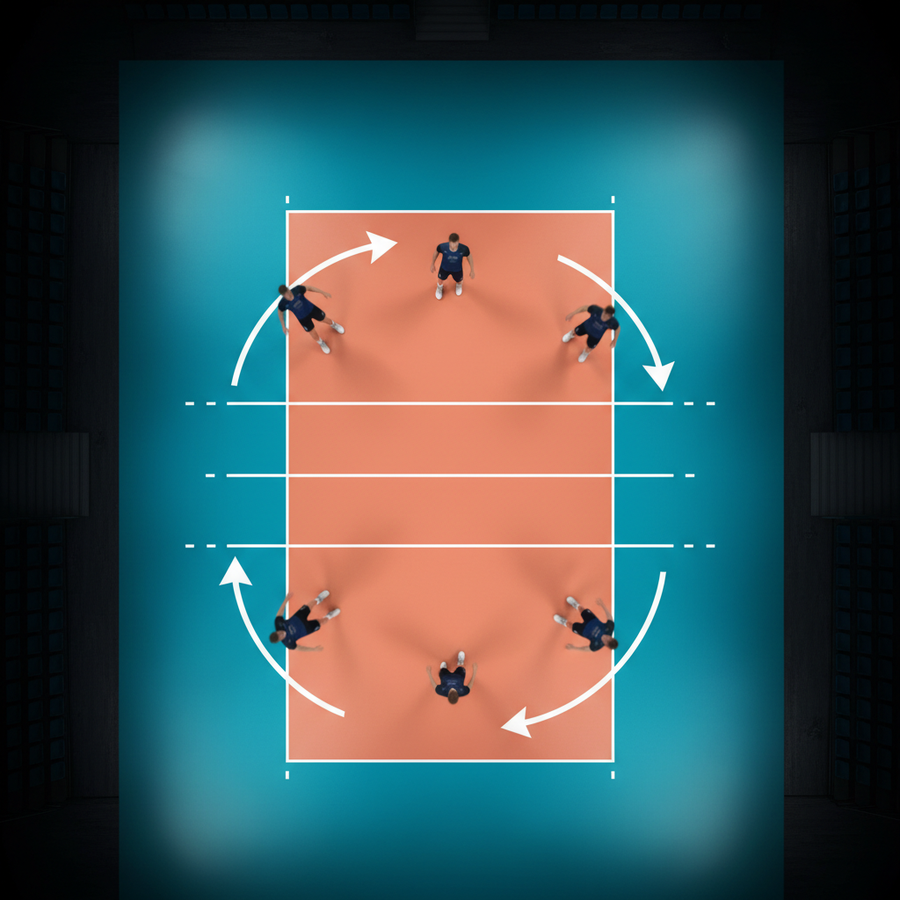
Volleyball is played six against six on a court divided by a net. Each team fields six players simultaneously, and those players are required to rotate positions each time their team wins back the serve from the opposing side. Rotation ensures that every player cycles through each of the six court positions over the course of a set, which means every player is expected to contribute from both the front row and the back row at different points in the game. This is fundamentally different from sports like basketball or football where players largely remain in designated areas throughout.

The rotation system exists partly for competitive balance and partly as a structural rule that prevents teams from permanently placing their strongest players in the most advantageous positions. When a team wins a rally on their opponent's serve, the point is awarded and the ball passes to them for their own serve. At this moment, the serving team rotates one position clockwise before the next serve takes place. This means the player who was in the right back position moves to the serving position, which is the right back, and every other player shifts one place clockwise around the court. For a full breakdown of how these rules connect to the wider structure of the sport, the volleyball guide on Effort Does It is a useful starting point.

The Six Positions and What Each One Does

The six positions on a volleyball court are numbered and arranged in two rows of three. Positions 1, 6, and 5 form the back row from right to left, and positions 2, 3, and 4 form the front row from right to left. Position 1 is the serving position in the right back. Position 4 is the outside hitter position in the left front. Position 2 is the right side or opposite position in the right front. Position 3 is the middle front, occupied by the middle blocker. Position 6 is the middle back, and position 5 is the left back.

In terms of specialist roles, outside hitters are the primary attackers and typically receive the most sets during a game. They attack from the left side of the court in position 4 and are expected to be consistent passers and effective in blocking when rotated to the front row. Middle blockers play in positions 3 and 6 and are responsible for blocking at the net and running quick attacking plays close to the setter. The setter, who is the player who delivers the second touch to set up attacks, is not a numbered court position but a specialist role that any player can fill depending on the team's tactical system. Liberos are specialist back row defenders who wear a different coloured jersey and cannot serve, attack above the net height, or rotate into front row positions.

Positional Faults and Overlap Rules Beginners Must Know

Before the serve is made, all six players must be in their correct rotational positions relative to each other. This is the rule that catches most beginners. The requirement is not that players stand in fixed zones but that each player is in the correct position relative to the players immediately adjacent to them. A front row player must be closer to the net than the back row player in the same column, and a right-side player must be further right than the player in the middle, and further right than the player on the left.

A positional fault, also called an overlap, is called when a player is not in their correct position relative to an adjacent player at the moment the serve is made. For example, if the left back player is standing too far forward and crosses the vertical line of the left front player, the referee will call an overlap fault. Once the serve is made, players are free to move anywhere on their side of the court. This means specialist players such as setters and liberos can move to their preferred functional positions immediately after the serve, which is why watching a volleyball team during the serve can look very different from their positioning a few seconds later once play is underway.

How Rotations Work in Practice During a Match

In practice, most volleyball teams use a system that allows their setter to function from the same area of the court regardless of which rotational position they are technically in. The most common arrangement at club level is the 5-1 system, where one dedicated setter plays all six rotations. When the setter is in the back row, they set from behind the attack line. When they rotate to the front row, a different player takes on more attacking responsibility to compensate. The 6-2 system uses two setters who alternate, each setting when they are in the back row, which keeps two attackers in the front row at all times.

For beginners playing recreational or introductory volleyball, the most important rotation concepts to internalise are the clockwise rotation direction when winning back the serve, the positional rules that apply before each serve, and the freedom of movement that exists once the serve is in play. Attempting to memorise specialist systems before these basics are secure will cause confusion rather than clarity. Practising rotations deliberately in training, where players call out their positions before each serve, is a simple method coaches use to build rotation awareness without slowing the game down.

Summary

Volleyball rotations follow a consistent clockwise pattern each time a team wins back the serve, and the six positions each carry specific responsibilities that shape how a team attacks and defends. Understanding the overlap rules before each serve and the freedom of movement that follows is what allows a beginner to follow and participate in the game with confidence. The beginner's guide on Effort Does It covers the foundational rules and skills needed to get started in volleyball.