Badminton Training Reference

Why Do You Arrive Late to the Shuttle in Badminton?

Arriving late to the shuttle is one of the most frustrating problems in badminton because it makes every shot harder and every recovery slower. It usually happens because the player is losing time in the first step, the split step, the braking phase, or the recovery path after the previous shot. 

This article explains why that delay happens and how to fix it with better mechanics, smarter training, and more badminton-specific practice.

Why Do You Arrive Late to the Shuttle in Badminton?

Why the Delay Happens

Most players think they are late because they are not fast enough, but that is only part of the story. In many cases, the real issue is poor timing, weak reading of the opponent, slow first movement, or wasted steps before contact.

Badminton is not a sport where speed alone solves the problem. The shuttle travels quickly, the court is small, and players must react, stop, push, and recover in a very short space of time. If any part of that chain is delayed, even by a fraction, the player arrives under pressure and loses control of the rally.

This is why some players look quick in straight-line drills but still seem slow during actual games. The issue is often not top speed. It is the ability to begin moving at the right moment and take the shortest useful path to the shuttle.

The Movement Problem

Late arrival usually comes from a breakdown in movement efficiency. The split step may happen too early or too late, the first push may be weak, and the recovery step may send the player in the wrong direction before they correct themselves.

A lot of this comes down to the body absorbing force and producing force again quickly. If the legs cannot brake well, the player cannot change direction cleanly. If the hips and ankles are not stable, the player loses force through the ground and takes extra steps to recover balance. That adds time.

Coaches often describe this as a problem of reading, loading, and launching. Reading means picking up cues from the opponent. Loading means getting into a position where the legs can store and release force. Launching means pushing off cleanly without drifting or crossing the feet too late. When one part is weak, the whole movement slows down.

How It Shows Up in Matches

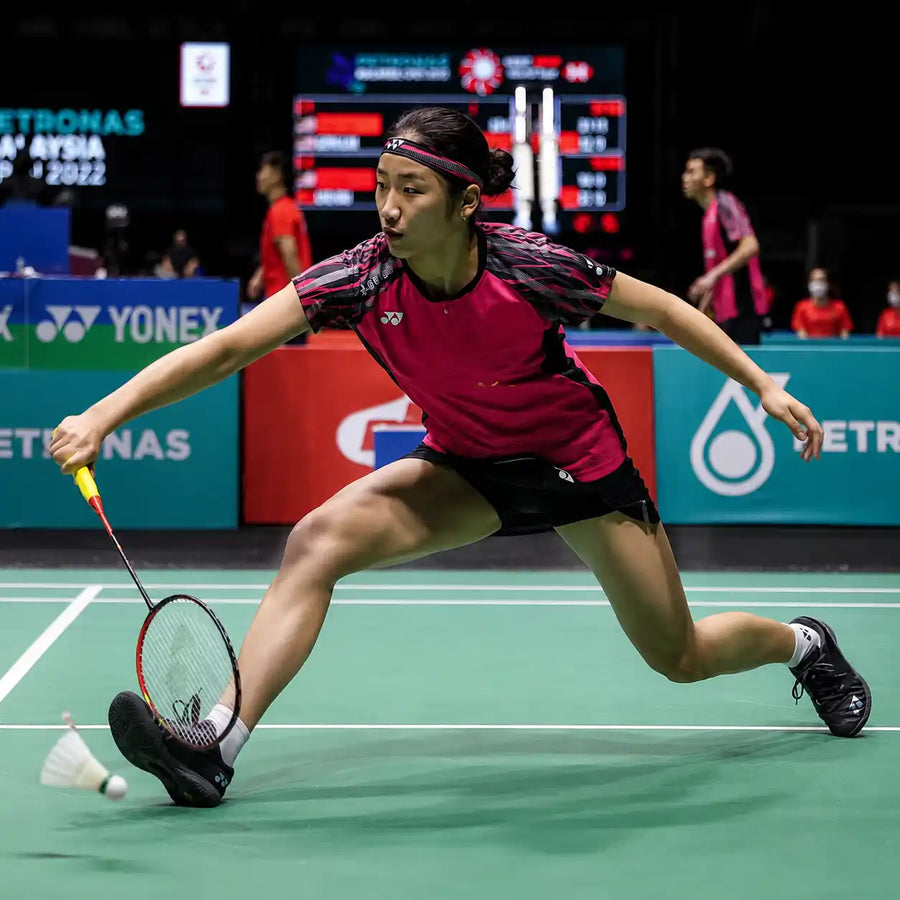
The problem becomes obvious in real rallies. A player may reach the rear court late and end up hitting a weak clear instead of attacking. They may arrive a step late at the net and have to lift the shuttle rather than playing a tight net shot. They may also recover slowly after a smash and get exposed on the next shot.

This often gets worse under pressure. In longer rallies, players stop moving with the same sharpness, so the delay becomes more visible. They begin to rely on last-second reaches, stretched lunges, and off-balance shots. That creates a cycle where each late movement causes the next one to be harder.

It also shows up against deceptive opponents. If a player watches the shuttle instead of the hitter, they start moving after the shuttle has already been played. That half second of hesitation is enough to make good footwork look ineffective.

Common Mistakes and Fixes

One common mistake is chasing more speed without fixing movement quality. Players do more ladders, more sprints, or more random footwork patterns, but they still arrive late because the real issue is timing and braking.

Another mistake is thinking that more games alone will solve it. Match play helps skill, but it does not automatically improve efficient movement. If the player keeps repeating poor habits, those habits become more automatic.

A third mistake is ignoring the split step. Many players either do not use it properly or land at the wrong time, which ruins the first push. Another common issue is overstriding, where the player takes a big reach step instead of a sharp, compact move. That wastes time and makes recovery slower.

The first fix is better reading of the opponent. Players should watch the hitter, racket preparation, and body shape, not just the shuttle after it has already left the racket. Earlier recognition gives the body more time to move. For broader context, the badminton guide helps connect movement quality with overall match play.

A useful coaching cue is to think of movement as a sequence: see, load, push, stop, recover. When one part is late, the whole rally suffers. More focused badminton training & conditioning work can then turn that sequence into a repeatable skill.

Summary

Arriving late to the shuttle is usually a timing and movement problem, not just a speed problem. Better reading, first-step timing, and recovery can make a big difference. For a simpler starting point, use the beginner's guide.